Imagine the city
Traders filled the streets, carts transported wine and olive oil towards the port, and citizens gathered in the forum to discuss business and public affairs.
From Roman Tarraco to the medieval city and the dramatic siege of 1811, discover the layers of history hidden among Tarragona’s streets.
Roman monuments, medieval streets and the scars of the Napoleonic siege coexist within the same historic landscape.
As you explore Tarragona, you will discover how each period transformed the city without completely erasing what came before. Ancient walls became medieval houses, Roman streets shaped later neighbourhoods and historic squares witnessed some of the city’s most dramatic events.
The birth of a Mediterranean capital
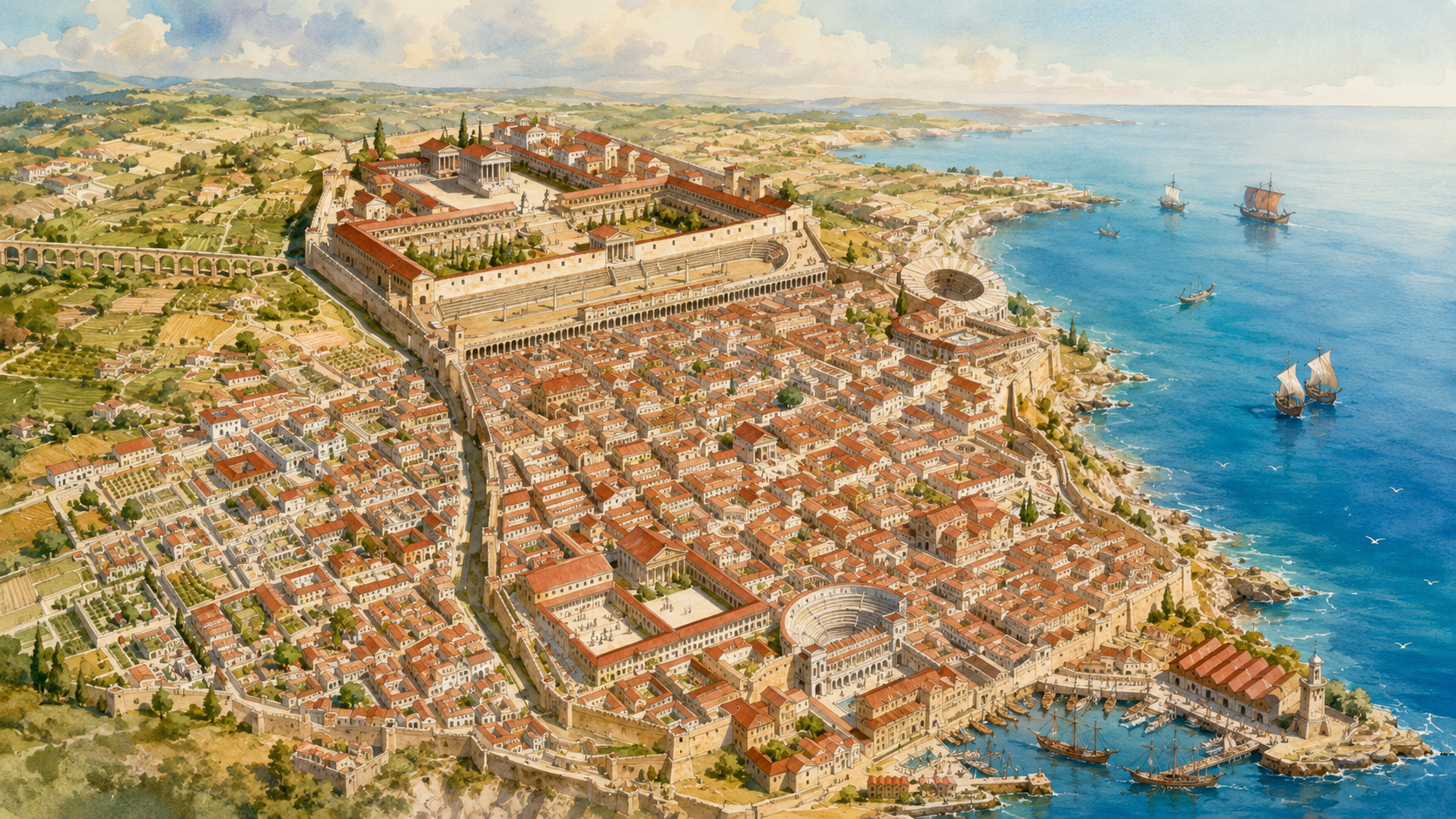
An imagined view of Tarraco at the height of the Roman Empire.
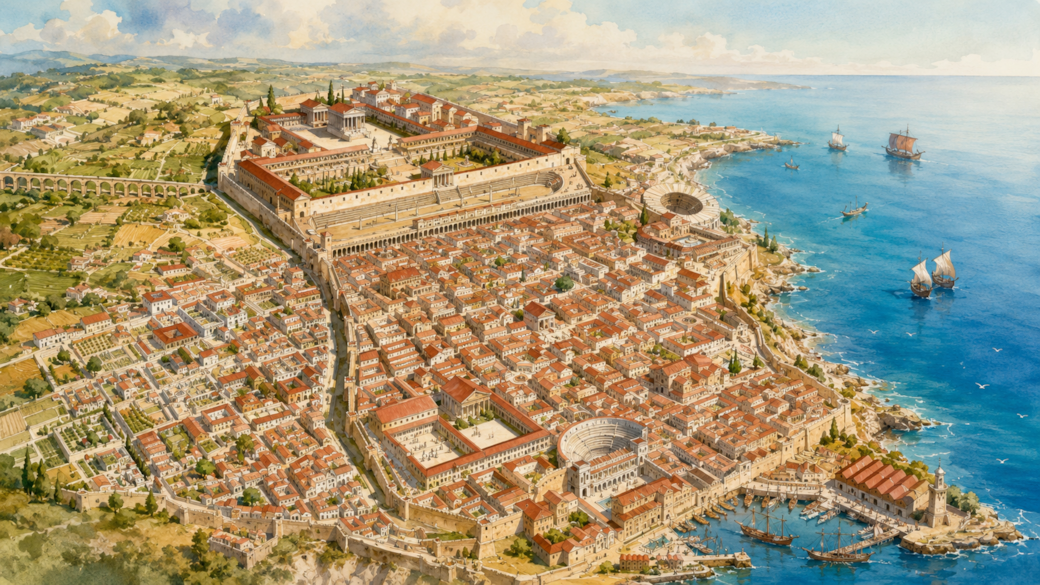
Before exploring Tarragona’s Roman monuments, take a moment to imagine the city as it was more than two thousand years ago: a powerful provincial capital built on terraces overlooking the Mediterranean.
Tarraco was filled with temples, public squares, markets, administrative buildings and monumental places of entertainment.
The story of Roman Tarragona began in 218 BC, during the Second Punic War. Roman troops arrived on the Iberian Peninsula to confront the Carthaginians and established a military base beside an existing Iberian settlement.
Its position was ideal: the hill was easy to defend, while the natural port connected the city with the rest of the Mediterranean. The military camp gradually developed into Tarraco, the first major Roman settlement on the Iberian Peninsula.
As Rome expanded its control, Tarraco became an important administrative, commercial and military centre and later the capital of the province of Hispania Citerior.
Tarraco’s prestige increased when Emperor Augustus stayed in the city while directing military campaigns in northern Hispania. For a time, important decisions concerning the Roman world were made from Tarragona.
In the centuries that followed, the city was transformed with temples, baths, markets, administrative buildings and monumental entertainment venues.
The upper part of Tarraco was reserved for political and religious power, while the residential neighbourhoods extended downhill towards the port and the sea.
Traders filled the streets, carts transported wine and olive oil towards the port, and citizens gathered in the forum to discuss business and public affairs.
Thousands of spectators gathered in the circus to watch chariot races or descended towards the amphitheatre for public spectacles.
Roman walls, vaults and foundations survive beneath modern homes, inside shops and among the streets of Tarragona’s Part Alta.
Tarragona’s ancient history remains visible throughout the city, often incorporated into later buildings and streets.
Walk beside some of the oldest surviving Roman fortifications outside Italy.
Discover the remains of the monumental administrative centre that once dominated the upper city.
Enter the ancient vaults that once supported the stands used by spectators of the chariot races.
Visit the Roman arena overlooking the Mediterranean and the remains of later Christian buildings.
Begin at the Roman walls, continue through the Part Alta towards Plaça del Fòrum, explore the Roman Circus and finish at the Amphitheatre beside the sea.
Approximately 45–60 minutesCathedrals, stone streets and a city reborn
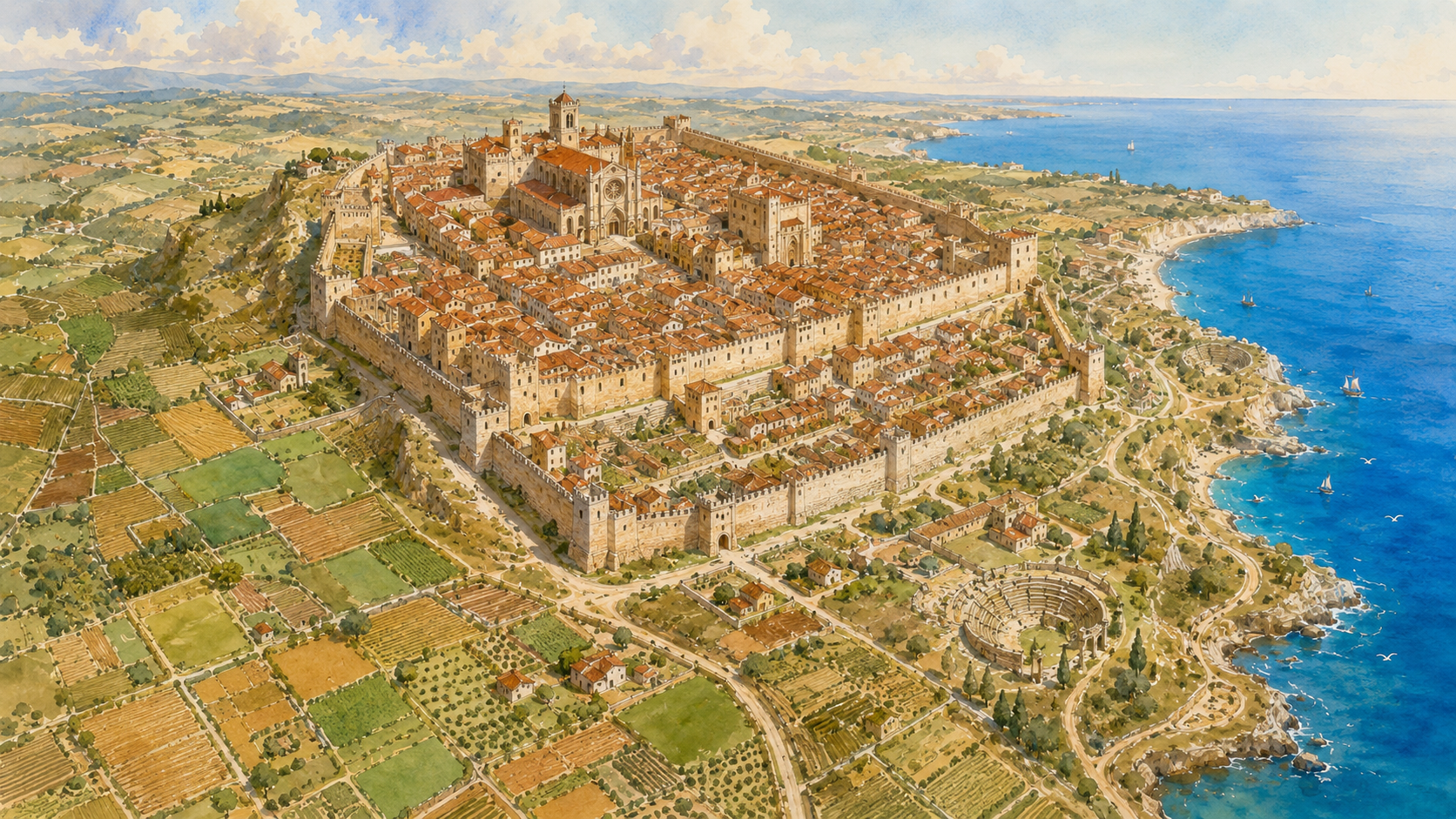
Medieval Tarragona grew among the remains of the Roman city.
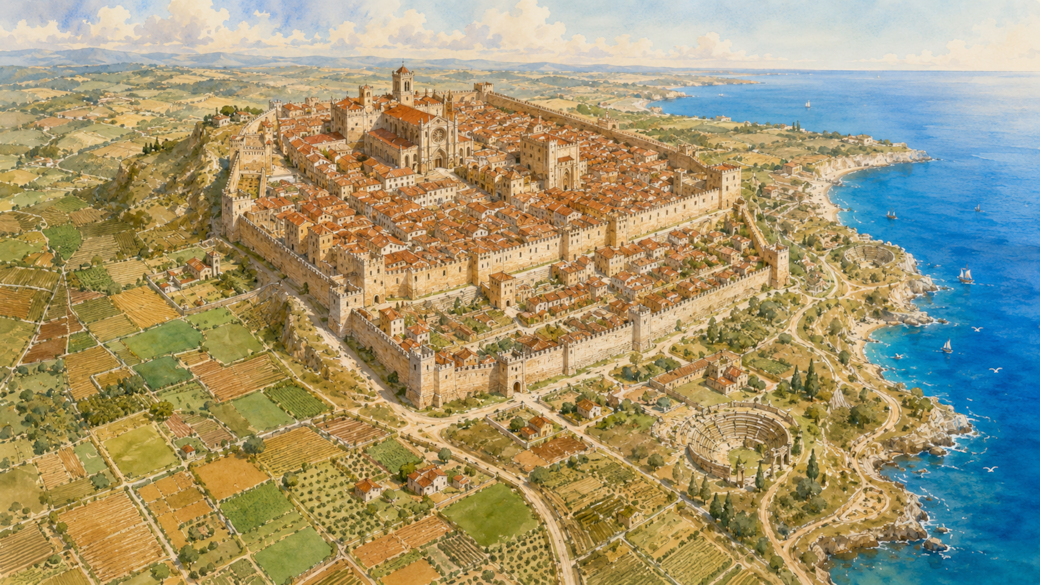
Medieval Tarragona grew among the remains of the Roman city. Ancient walls, vaults and monumental terraces were transformed into houses, streets, palaces and places of worship.
Rather than destroying the ancient city, medieval Tarragona adapted it, giving old stones and buildings an entirely new life.
After the decline of the Roman Empire, Tarragona went through centuries of profound change. The once monumental Roman capital lost much of its population and importance, although its enormous walls and buildings never completely disappeared.
In the early 12th century, Christian Tarragona began to be reorganised and repopulated. The upper part of the ancient city once again became the centre of political and religious power, protected by the old Roman walls.
New streets, workshops, markets and homes appeared between the surviving Roman structures.
Tarragona Cathedral was built on the highest point of the city, over the former sacred precinct of Roman Tarraco. Its construction began in the Romanesque period and continued over several centuries.
This long history explains its combination of Romanesque and Gothic elements. The Cathedral became the heart of medieval Tarragona, surrounded by the homes of clergy, noble residences, workshops and small shops.
When you stand in Pla de la Seu and look towards the Cathedral façade, you are seeing the place where Roman, medieval and modern Tarragona meet.
Medieval Tarragona was a compact city protected by ancient fortifications and filled with merchants, artisans, clergy, travellers and local families.
The arcades of Carrer de la Merceria sheltered shops and market stalls, while artisans worked in the narrow streets surrounding the Cathedral.
Bells, animals, carts, craftsmen at work and vendors announcing their goods would have filled the streets throughout the day.
Walk through stone streets, vaulted arcades and historic squares where the medieval city is still easy to imagine.
Discover its Romanesque and Gothic architecture, cloister and centuries of religious history.
Stand before the monumental staircase and one of the most evocative views in the historic centre.
Walk beneath the medieval arcades that once sheltered traders, stalls and their customers.
Wander through the small streets and hidden corners associated with Tarragona’s medieval Jewish community.
Begin at Pla de la Seu, visit the Cathedral and its cloister, continue beneath the arcades of Carrer de la Merceria and wander through the small streets of the former Jewish quarter.
Approximately 45–75 minutesThe French assault of 1811
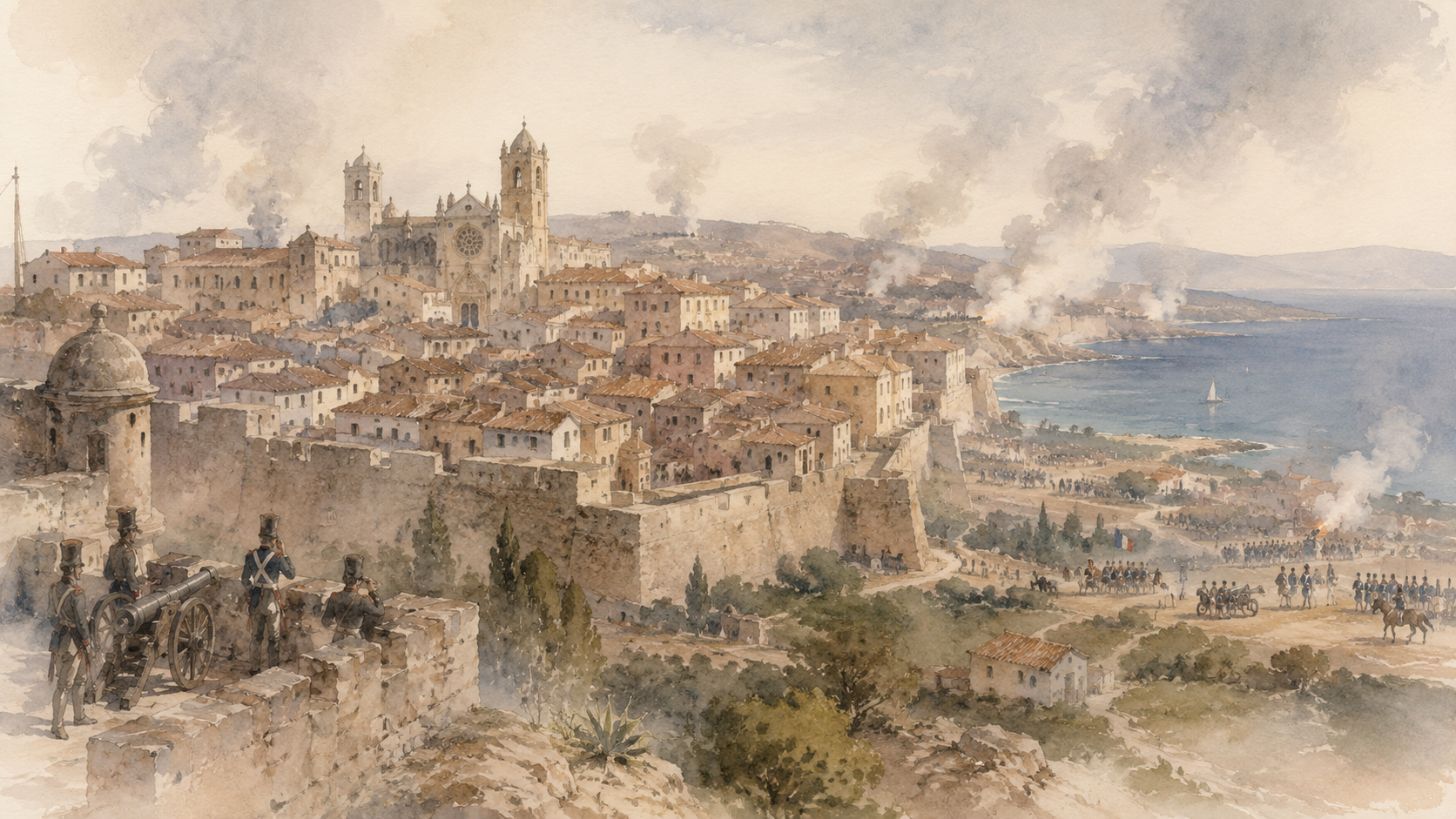
An interpretation of Tarragona during the dramatic siege of 1811.
In 1811, Tarragona became the setting for one of the most dramatic episodes of the Peninsular War.
For almost two months, the fortified city resisted Napoleon’s army before a devastating final assault changed Tarragona forever.
The Peninsular War began in 1808, when Napoleon’s forces occupied much of Spain. Tarragona remained an important defensive stronghold because of its port, its ancient walls and its strategic position on the Mediterranean coast.
After the French captured Lleida and Tortosa, Marshal Louis-Gabriel Suchet advanced towards Tarragona. His troops reached the surrounding area in early May 1811 and quickly encircled the city.
Inside the walls were soldiers, local residents and people who had sought refuge in Tarragona. Their plan was to resist until reinforcements arrived, but the promised relief force never came in time.
French artillery gradually destroyed Tarragona’s outer defences. One of the first major losses was the Fortí de l’Oliva, captured on 30 May.
The bombardment continued day and night. Food and water became increasingly scarce, buildings were damaged and hospitals struggled to care for the wounded.
The population lived with the constant sound of cannon fire and the fear that the walls might be breached at any moment.
The French army surrounded Tarragona, blocked its entrances and cut the fortified city off from the surrounding countryside.
After breaking through the defences, French troops advanced from the lower districts towards the fortified upper city.
The final assault caused enormous destruction and became one of the most traumatic moments in Tarragona’s history.
On 28 June 1811, the French army launched its final assault. After breaking through the defences, the troops advanced from the lower districts towards the fortified upper city.
Fighting continued through the streets and squares of Tarragona. The assault caused enormous destruction and the deaths of soldiers and civilians.
Tarragona remained under French occupation for more than two years. When the French withdrew in August 1813, they destroyed several strategic defensive points, leaving behind a city marked by hunger, poverty and devastation.
The walls, gateways, streets and memorials of Tarragona still preserve the memory of the siege.
One of the first key defensive positions to fall during the French advance.
The historic western entrance to the old fortified city and an evocative starting point for the route.
The Cathedral square stood within the final fortified section of Tarragona during the assault.
The monument on Rambla Nova commemorates those who defended Tarragona during the siege.
Begin near Portal del Roser and follow the old walls towards the Part Alta. Continue through the narrow streets to Pla de la Seu, then walk downhill to the monument dedicated to the defenders of 1811.
Approximately 45–60 minutesHistory is not only something you visit in Tarragona. It surrounds the place where you stay.
From the monumental centre of Roman Tarraco to the streets of the medieval city and the dramatic events of 1811, every walk through the Part Alta reveals another layer of Tarragona’s past.
Stay in historic Tarragona